

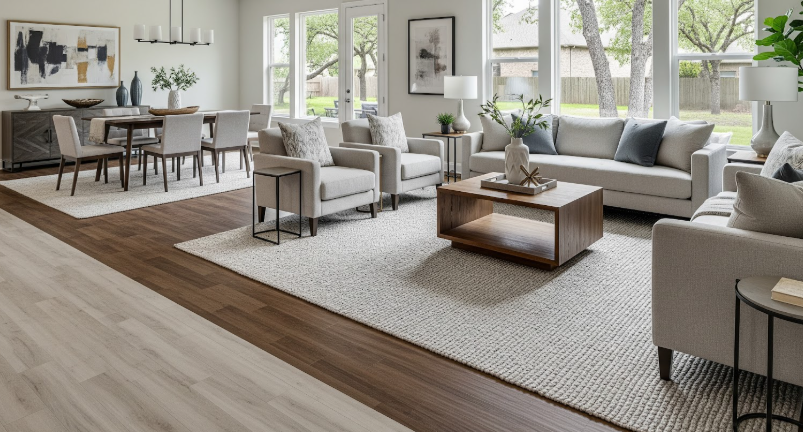
Why Rug Size Matters in Open-Concept Homes
Open-plan homes are popular across Little Rock because they feel bright, airy, and connected. But with all that open space, your furniture can easily “float” without the right visual anchors. That’s where the right rug size comes in. A properly sized rug doesn’t just look good—it defines zones, balances scale, improves acoustics, and creates a warm, pulled-together feel.
Whether your home features hardwood or luxury vinyl plank (LVP) flooring, the right rug can highlight the character of your floors rather than hiding them. It also protects high-traffic surfaces, softens sound, and helps bring a cohesive style to living rooms, dining areas, and blended seating zones often found in open layouts.
If you’re beginning updates to your Little Rock space and want help refining your floor-and-rug combination, Southern Floor Co. has plenty of flooring options and expert designers who can help you choose materials that work beautifully together.
The Biggest Rug Mistake: Going Too Small
Most homeowners under-size their rugs, especially in large, open rooms. A rug that’s too small chops the room in half visually, makes furniture arrangements feel disconnected, and creates a scattered look.
Here’s what “too small” looks like:
Coffee table touching all four edges of the rug
Sofa legs falling completely off the rug
Rug floating between furniture without anchoring anything
A walkway cutting through the rug’s center
If you’re unsure about sizing, go larger every time. A rug that spans the space makes your room feel intentional, inviting, and well-planned.
Living Room Rug Rules for Open-Concept Layouts
Because open rooms often combine living, dining, and kitchen zones, the living area rug usually sets the tone for the entire space.
Rule 1: All Furniture Legs on the Rug
This is the most polished look for open spaces.
Ideal rug sizes:
9' x 12'
10' x 14'
Benefits:
Creates one unified seating zone
Works beautifully in larger Little Rock homes
Balances wide-plank hardwood and LVP visually
Rule 2: Front Legs on the Rug
A popular choice for mid-sized open rooms.
Ideal rug sizes:
8' x 10'
9' x 12'
Benefits:
Offers plenty of coverage without overwhelming the floor
Gives you a grounded look even with sectional sofas
Rule 3: Coffee Table + Breathing Room
For compact areas or flex rooms, make sure the rug extends at least 18–24 inches beyond all sides of the coffee table.
Ideal rug sizes:
6' x 9'
8' x 10'
Benefits:
Works well when the living area shares space with the dining area
Shows off more of your hardwood or LVP while still anchoring the seating area
Choosing Rug Sizes for Sectional Sofas
Sectionals demand larger rugs because of their footprint. To visually “contain” a sectional, choose a rug that covers the entire area under the sofa’s L-shape.
Recommended sizes:
9' x 12'
10' x 14'
Avoid:
Rugs that leave the chaise portion bare
Narrow rugs that cause rugs to buckle under furniture legs
If your sectional is oversized or curved, consider going one size up for proper balance.
Dining Room Rug Rules in Open Concepts
Open-plan dining areas remain visible from every angle, so rug sizing here makes a dramatic difference.
Rule: Rug Extends 24 Inches Beyond All Sides of the Table
This ensures chairs slide smoothly without catching on the edge.
Ideal sizes:
8' x 10' for a 6-seat table
9' x 12' for an 8-seat table
10' x 14' for an oversized dining table
For round tables:
Use round rugs
Rug should widen 24 inches past the table’s circumference
Pairing the right rug with hardwood is a popular choice, but LVP handles sliding chairs well too—especially for families with young children.
If you want more inspiration for flooring that works well under dining room rugs, browsing different species, stains, and textures of hardwood flooring can help spark ideas: hardwood flooring.
Rug Sizing for Long or Irregular Open-Plan Spaces
Some Little Rock homes have uniquely shaped open layouts—such as long rectangular living rooms or blended living/dining/sunroom combos. The right rug setup can help divide or emphasise each zone.
Zone 1: Large Living Area
Choose one oversized rug to span the whole seating area.
Size suggestion: 10' x 14'
Zone 2: Small Adjacent Sitting Area
Option 1: Use a smaller coordinating rug (5' x 7' or 6' x 9')
Option 2: Leave it bare to showcase the flooring
Zone 3: Dining Area
Use a rug that matches the living area’s scale and tone.
Size suggestion: 9' x 12'
Zone 4: Hallway-Style Passage
Use runners to connect spaces visually without overwhelming the floor.
The key is consistency—matching tones, textures, or patterns helps open-plan layouts feel intentional instead of patchy.
Rug Sizing Rules for Bedrooms in Open-Plan Lofts
Loft-style open concepts are becoming more common in newer Little Rock builds and renovated homes. Bedrooms in these spaces rely heavily on rugs for structure.
Bed Size: King
Ideal rug sizes:
9' x 12'
10' x 14'
Bed Size: Queen
Ideal rug sizes:
8' x 10'
9' x 12'
Best placement:
Rug starts under the nightstands
Rug extends 18–24 inches beyond the sides
This setup softens footfall on LVP or hardwood and creates a warm zone that feels anchored without the need for partition walls.
Rug Sizing for Entryways in Open Concept Homes
Entryways that open directly into a living room or kitchen benefit from well-sized rugs that provide immediate structure without clutter.
Best Rug Sizes
4' x 6'
5' x 7'
6' x 9' for oversized foyers
Make sure your door can swing freely over the rug—thinner, tightly woven options often work best.
How to Coordinate Rugs with Hardwood or LVP
Your floors are the largest design surface in your home. The right rug complements them without competing for attention.
With Hardwood Flooring
Warm floors (honey, chestnut): choose neutrals or cool tones
Cool floors (gray, driftwood): choose warm or earthy rug colors
Dark floors: choose lighter rugs for contrast
If you love the look of hardwood, it may help to see more style ideas and colors. You can explore a wide range of hardwood flooring varieties to refine your pairing options: hardwood flooring.
With LVP Flooring
Wood-look LVP: choose a rug one or two tones lighter
Stone-look LVP: lean into soft textures
High-variation LVP: choose simple rug patterns to balance movement
A good rule: let one surface be bold and the other be calm.
When Multiple Rugs Should Match
In an open layout, you’ll often have several rugs visible at once. They don’t need to be identical, but they do need to feel cohesive.
Good combinations include:
Shared color families
Shared patterns (stripes, geometrics, or subtle textures)
Shared materials (wool blends, natural fiber)
Avoid rugs that fight each other visually—especially if the flooring has a strong grain pattern.
Choosing Rug Shapes for Open Plans
Rectangular rugs are the most common, but other shapes can define areas creatively.
Round Rugs
Great for:
Dining tables
Small reading nooks
Corner seating arrangements
Runner Rugs
Great for:
Walkways
Kitchen zones
Long living rooms
Oversized Square Rugs
Great for:
Large symmetrical rooms
Rooms with centered furniture arrangements
The shape should complement the layout, not complicate it.
Layering Rugs: Yes or No?
Layering can add warmth, texture, and personality, but it needs to be intentional.
Layering works when:
You use a large neutral base rug (jute or flatweave)
You place a patterned rug on top to define the seating area
Your flooring is neutral and doesn’t have strong grain variation
Layering does not work well when:
Your flooring has heavy patterns
Your rugs have clashing colors
The room already feels busy
In open plans, subtlety goes a long way.
Protecting Your Floors Under Rugs
Whether you have hardwood or LVP, the right rug pad protects your floors and keeps the rug from slipping.
Use pads that are:
Non-staining
PVC-free
Made specifically for vinyl or hardwood
Avoid using rubber mats directly on flooring—they can cause discoloration.
When to Add a Rug (And When to Skip It)
You should add a rug when:
Your open layout feels too echoey
Furniture feels disconnected
You want visual warmth
You want to soften footfall on rigid flooring
You can skip a rug when:
Your flooring is a major visual star
You want ultra-minimalist design
Your layout is narrow and rugs make it feel crowded
The “right answer” always depends on your space and lifestyle.
Transform Your Open-Plan Home with the Right Rug
A perfectly sized rug brings balance, structure, and comfort to any open-plan home in Little Rock. It highlights your flooring, pulls your furniture together, and adds the kind of softness that makes a big room feel lived-in and welcoming. Whether you’re working with hardwood or LVP, the right rug makes all the difference.
If you’re exploring styles for your home or need pairing suggestions for your new flooring and rugs, feel free to reach out to us. Our team is always here to help you design a space that feels complete, comfortable, and beautifully coordinated.


